
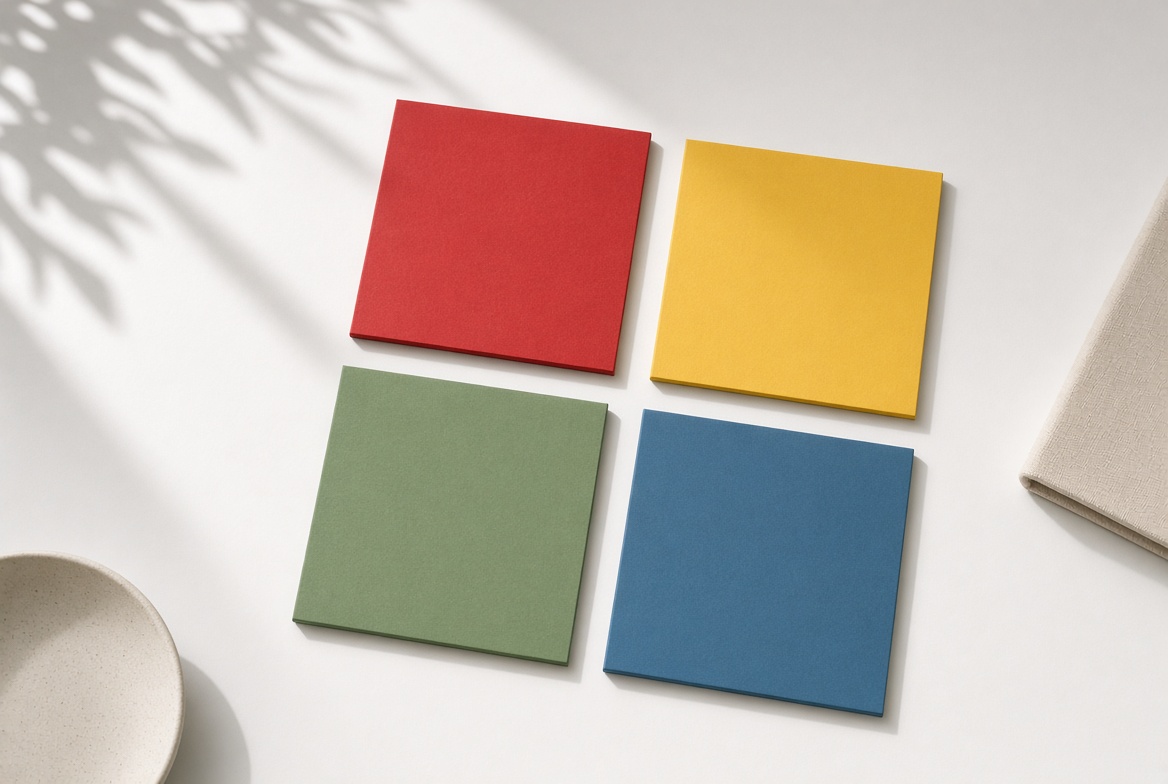
People take a color quiz, a DISC profile, and a four-letter test in one week, then want one word to equal one letter to equal one crayon. It will not. Some blurbs rhyme. Rhyme is not measurement. This page says what this site means by its four colors, where a loose DISC analogy holds, and where True Colors, Hartman, and the old temperaments refuse to convert. None of these systems is scientifically equivalent to any other.
The quiz here is the four-color test. Yellow means drive. Red means expression. Blue means analysis. Green means stability. Questions are original. You may be high on two colors. It is not the official True Colors program, and it is not an official FPA product. FPA names branded instruments, not this page. Do not paste an FPA result onto these labels. The local sketch is the four-color article.
What this site means by each color
Yellow is drive: a decision that can be checked, impatience with a stalled room, a willingness to choose and revise. It is not a job title, and it does not include the close. Closing is the file sent and the date kept. A driven person can leave ten open loops because the next target felt better than the ending. Red is expression: visible energy and a bias toward starting. You can be easy company and still drop the follow-up. Talking a lot is not the same as hearing what people asked.
Blue is analysis: the missing piece and a definition of done. You may be late because done moved. Care is not the same as being right. Green is stability: a pace that holds, a known team, work finished after it stops being exciting. It is not passivity. The useful version says the no in the room. The expensive version says yes and calls the extra load loyalty. Two highs are normal, not a scoring error. Yellow with Blue pushes and also wants a check. Red with Green wants contact inside a smaller circle.
Where DISC is close, and where it breaks
DISC here is the quiz and the note on DISC styles. The four words are Dominance, Influence, Steadiness, and Conscientiousness. That last word is a trap: in DISC it means a workplace taste for accuracy, not the Big Five trait of the same name. This site's version is an informal questionnaire, not a licensed profile.
A common loose analogy pairs Yellow with D, Red with I, Green with S, and Blue with C. Call it an analogy. The questions differ, and you can be high on two colors or two DISC letters. Double highs are normal, not errors to round away. Blue on this quiz, DISC C, and Big Five conscientiousness are three different constructs that only rhyme in a workshop. The grid below is a name-collision guard. It includes True Colors so you can see that the crayon words already disagree.
| Question | This site | DISC, loosely | True Colors, different system |
|---|---|---|---|
| Drive and close | Yellow means drive. Closing is a separate habit, not the color. | D, as an analogy only | Orange is action and freedom. Gold is duty and planning. Neither is named Yellow. |
| Expression | Red | I, as an analogy only | No Red on that map. Blue there means compassion, which is not this Red. |
| Analysis | Blue | C | Green (not Blue) |
| Stability | Green | S, as an analogy only | Gold is duty and planning. Blue is relationships. This Green is neither. |
True Colors and Hartman use other crayons
True Colors, associated with Don Lowry and built from Keirsey temperament ideas, uses another box. Blue means relationships and compassion. Gold means duty and planning. Green means analysis and competence. Orange means action and freedom. This site has no Gold and no Orange. This site's Blue is analysis, and True Colors puts analysis on Green. This site's Green is stability, while True Colors puts duty and planning on Gold and relationships on Blue. If you arrive as a True Colors Blue, you may mean compassion. On this page Blue means analysis. Name the system or the sentence is noise.
Do not convert Orange into Red, or Gold into Yellow. Orange there is action and freedom. Red here is expression. Gold is duty and planning. Yellow here is drive. A duty-bound planner and a person who wants the decision now are often arguing with each other, not one person described twice. Keirsey's Artisan, Guardian, Idealist, and Rational sit closer to that True Colors palette than to this site's crayons. Artisan is nearer Orange, and the letter cluster on this site is explorers. Guardian is nearer Gold: sentinels. Idealist is nearer True Colors Blue: diplomats. Rational is nearer True Colors Green: analysts. Closer is not the same test. Those group pages are about letters, not crayons.
Classical sanguine, choleric, melancholic, and phlegmatic language is a third map, not Keirsey. See the four temperaments. A chart that sets choleric beside this site's Yellow is decoration, not a finding. Hartman is different again. The Hartman Color Code uses motive: Red for power, Blue for intimacy, White for peace, Yellow for fun. This site has no White. Hartman's Red is not expression. Hartman's Yellow is fun, not drive. Hartman's Blue is intimacy, not analysis. Do not glue White onto Green. Stability here is a pace, not a motive called peace.
Letters and trait scores are different questions
The 16 types, from the letter quiz, are preference letters. They ask, in a popular form, about attention, pattern versus concrete detail, the criterion you trust when people and rules conflict, and whether you want the plan settled. They do not ask you to pick a color. An analyst-leaning code is not this site's Blue, and it is not True Colors Green, even if someone calls all three analytical. You can have that letter pattern and score low on Blue here. The group pages above are about letters. They are not color pages. Do not paint them.
The Big Five quiz on this site is a degree, not a crayon. The quiz is an informal original questionnaire, not the NEO-PI-R and not the IPIP. Openness is not a color. Conscientiousness is not a letter and not DISC C. Extraversion is not Red. Agreeableness is not Green. Neuroticism has no crayon here, which is why two cheerful profiles can still be having different months. DISC versus the 16 types versus the Big Five is the page that keeps those three apart. They are not scientifically equivalent. These color labels do not carry the trait literature. The letters are a commercial vocabulary with a weak record as categories. DISC is pace language. True Colors, Hartman, and FPA are their own products.
What to do when two results disagree
Write the behavior, not the brand. Who decided, who started the conversation, who checked the draft, who kept the week from thrashing, who dropped the close. Then ask which description predicted a normal month. If Yellow described the decisions and Green described the week, keep both. If a DISC D result clashes with a low-drive color, look at the job before you look for a broken test. A role can force a pace. A bad week can fake a trait. If the letter test flipped, read the bar. A near tie is not an order to repaint yourself Orange, Gold, or Red.
Use the other person's actual definition. Hartman's Red means power, not expression. True Colors Blue means compassion, not analysis. An FPA badge means that product's own rules, which this page does not score. Repeat the definition before you agree you are the same color. Keep the result that names a cost, not only the one that flatters: drive that will not listen, expression that will not finish, analysis that will not ship, stability that will not say no. Leave each map in its own words. On this site Yellow stays drive, Red expression, Blue analysis, and Green stability. Two honest disagreements are two answers to two questions. The calendar, not a conversion chart, is what you can check on Monday.